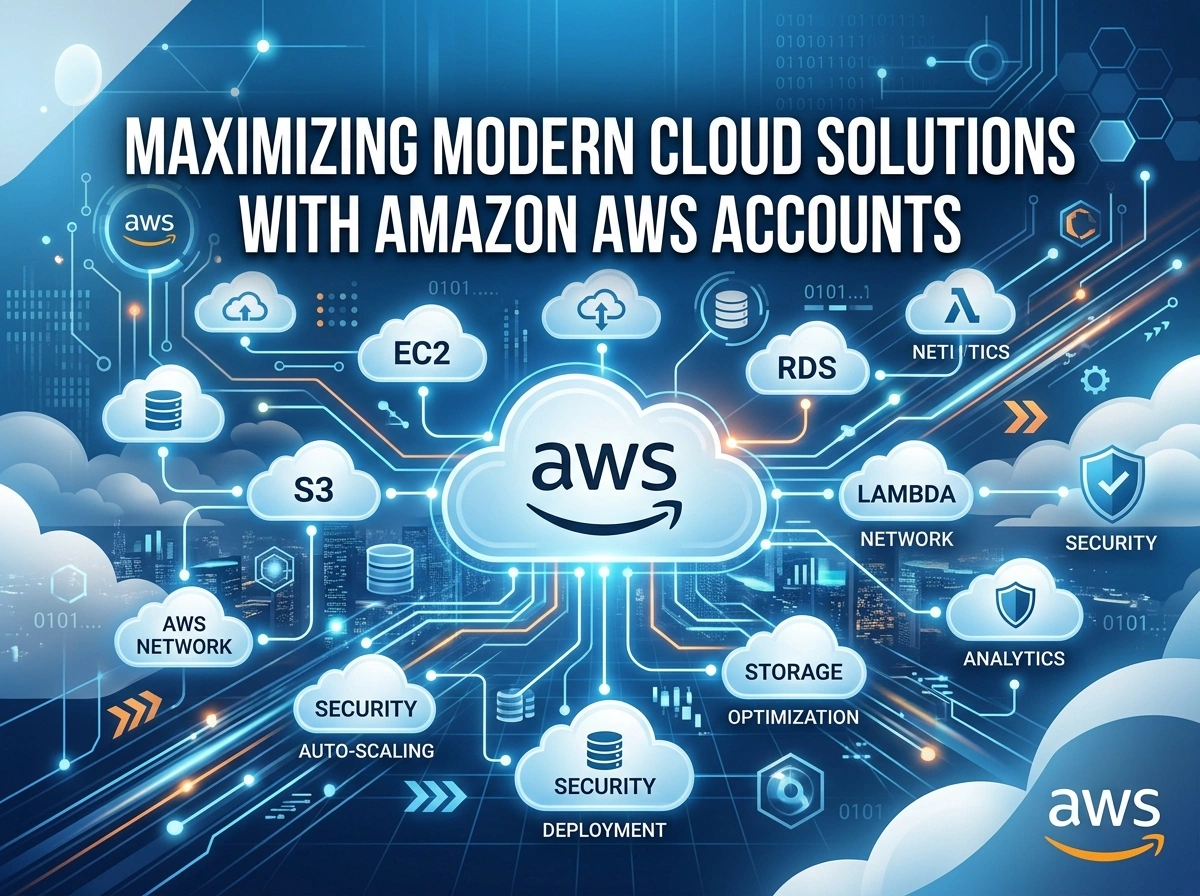
Cloud computing has fundamentally changed how businesses operate and scale in the digital era. Companies no longer need to invest heavily in physical servers or maintain expensive on-premises data centers. Instead, they rely on flexible digital infrastructure that can be accessed from anywhere on the globe. Amazon Web Services (AWS) stands at the forefront of this massive technological shift, commanding a significant portion of the global cloud market.
An AWS account serves as the primary gateway to this expansive and powerful ecosystem. It provides organizations with the foundational tools required to build, deploy, and manage applications on a truly global scale. Understanding how to leverage these accounts effectively is crucial for any modern business strategy.
Readers of this comprehensive guide will learn the structural components of AWS accounts, explore the strategic benefits of cloud adoption, and discover best practices for resource optimization. By mastering these foundational elements, IT professionals and business leaders can enhance their operational agility, improve security postures, and maintain a competitive edge in an increasingly digital marketplace.
The Core Components of an AWS Account
An AWS account is much more than a simple login credential. It acts as a comprehensive container for your cloud resources, security configurations, and billing information. When you first establish an account, you receive root access. This root user possesses unrestricted permissions across all services and resources. Because of this sweeping access, security professionals strongly advise against using the root account for daily administrative tasks.
Instead, administrators use the AWS Identity and Access Management (IAM) service. IAM allows you to create specific users, groups, and roles with highly granular permissions. This ensures that a developer only has access to the tools they need, preventing accidental modifications to critical systems.
Another critical component is the Virtual Private Cloud (VPC). A VPC acts as your private networking environment isolated within the public cloud. It lets you launch resources into a virtual network that you completely define and control, allowing for custom IP addressing, subnets, and routing tables. Finally, the billing and cost management dashboard serves as a central hub for financial oversight. It tracks resource consumption in real-time, applies complex pricing models, and helps organizations forecast future expenses accurately.
Benefits of AWS for Businesses: Scalability, Security, and Innovation
Organizations migrate their workloads to AWS to unlock three distinct and powerful advantages: scalability, security, and rapid innovation. Scalability allows companies to adjust their computing resources based on real-time demand. A retail website, for example, can automatically add server capacity during a massive holiday sale to handle web traffic, and then reduce it when traffic normalizes. This dynamic elasticity prevents the costly over-provisioning of hardware and ensures a smooth user experience.
Security represents another major operational benefit. Amazon maintains massive data centers with rigorous physical and digital protections that most individual companies could never afford to implement on their own. They operate under a shared responsibility model. AWS secures the underlying infrastructure, while customers are responsible for securing the data they put into the cloud. This arrangement provides a highly robust foundation for meeting strict compliance standards like HIPAA, GDPR, and SOC 2.
Furthermore, AWS accelerates business innovation. Developers have immediate access to hundreds of ready-to-use services. They can experiment with advanced machine learning algorithms, complex data analytics, and Internet of Things (IoT) applications without making significant upfront capital investments. This low barrier to entry encourages rapid prototyping and significantly faster time-to-market for new digital products.
The sheer volume of tools within the AWS ecosystem can seem overwhelming to new users. However, most modern cloud solutions rely heavily on a few foundational services that form the backbone of cloud architecture. Amazon Elastic Compute Cloud (EC2) provides resizable compute capacity. It functions as the virtual server where businesses run their core applications, offering a wide variety of processor types and memory configurations.
For data storage, Amazon Simple Storage Service (S3) offers highly durable, infinitely scalable object storage. Companies use S3 for everything from storing website images and video assets to housing massive data lakes for business analytics. When it comes to managing structured data, the Amazon Relational Database Service (RDS) simplifies the setup, operation, and scaling of relational databases like MySQL, PostgreSQL, and Oracle.
Serverless computing has also completely transformed how modern developers write and deploy code. AWS Lambda allows you to run code in response to specific triggers without provisioning or managing any underlying servers. You only pay for the exact compute time consumed, down to the millisecond. Together, these core services form the essential building blocks for highly complex, fault-tolerant cloud architectures.
Strategic Advantages of Having Multiple AWS Accounts
As organizations grow and take on more ambitious projects, a single AWS account often becomes insufficient for managing complex workloads. Utilizing multiple AWS accounts provides several strategic advantages for enterprise-scale operations. First, it creates strong, impenetrable security boundaries. If a malicious actor compromises a development account, the critical production environment remains completely isolated and protected. This concept, known as reducing the blast radius, is a fundamental principle of modern cloud security.
Second, multiple accounts simplify cost allocation and financial tracking. Finance teams can easily attribute cloud spending to specific departments, individual projects, or isolated cost centers. This precise visibility prevents budget overruns and encourages financial accountability among engineering teams. Many businesses use AWS Organizations to centrally manage these multiple accounts, allowing administrators to apply overarching security policies and consolidate billing.
Companies looking to rapidly expand their infrastructure or bypass initial setup bottlenecks sometimes choose to Buy Amazon Aws Accounts to streamline deployment. Having pre-verified environments readily available can significantly accelerate the onboarding process for new development teams and facilitate immediate project launches without administrative delays.
Management and Optimization of Cloud Resources
Deploying resources in the cloud is only the first step of the journey. Effective management and continuous optimization are absolutely required to maximize the value of your cloud investment. Left unchecked, cloud costs can spiral out of control due to unused resources or inefficient architectures. Organizations must actively monitor their usage patterns on a daily basis.
AWS Cost Explorer provides detailed visual dashboards of past spending and accurately forecasts future expenses. It helps administrators identify sudden cost drivers and usage anomalies. Another essential optimization tool is AWS Trusted Advisor. This built-in service inspects your cloud environment and offers real-time guidance based on AWS best practices. It checks for hidden security vulnerabilities, performance bottlenecks, and opportunities to eliminate wasted spend.
For compute resources, AWS Compute Optimizer utilizes advanced machine learning to analyze historical utilization metrics. It then recommends the most cost-effective EC2 instance types and volumes for your specific workloads. By regularly reviewing these automated recommendations, IT teams can eliminate idle resources, right-size their infrastructure, and ensure they only pay for the exact resources they truly need.
The Growing Demand for AWS Infrastructure
The global appetite for reliable cloud infrastructure continues to expand at an unprecedented rate across all industries. Several macroeconomic and technological factors drive this surging demand. The massive transition to remote work has forced companies to digitize their operations rapidly. Traditional on-premises servers simply cannot provide the flexibility and accessibility required for a modern, distributed workforce.
Furthermore, digital transformation initiatives require massive amounts of computing power. Businesses are urgently modernizing legacy applications to improve customer experiences and increase operational efficiency. AWS provides the immense global footprint necessary to support these ambitious initiatives. With data centers located in multiple geographic regions around the world, companies can deploy applications physically closer to their end-users. This drastically reduces network latency and improves overall application performance.
Additionally, the rise of big data requires highly scalable storage and processing capabilities. Traditional data centers struggle to keep pace with the exponential growth of digital information generated by mobile devices and sensors. The cloud offers a practical, highly scalable solution for housing, processing, and harnessing the immense value of this corporate data.
Best Practices for AWS Account Security and Compliance
Securing an AWS account requires a proactive approach and strict adherence to established cybersecurity best practices. The very first line of defense is implementing Multi-Factor Authentication (MFA) for all users, especially the powerful root account. MFA adds an essential, uncompromisable layer of security by requiring a secondary verification method during the login process.
Administrators must also rigorously enforce the principle of least privilege. This means granting users and software applications only the specific permissions absolutely necessary to perform their defined job functions. IAM policies should be carefully crafted, rigorously tested, and regularly reviewed to prevent unauthorized access or privilege escalation.
Visibility into account activity is equally critical for a strong security posture. AWS CloudTrail records all API calls made within the account, creating a comprehensive audit log. This logging capability is crucial for security audits, resource tracking, and forensic troubleshooting. By continuously monitoring CloudTrail logs, security teams can quickly detect unusual behavior and respond to potential threats before they escalate into breaches. Organizations should also utilize AWS Config to continuously monitor and assess the configurations of their cloud resources against strict compliance guidelines.
Future Trends in Cloud Computing with AWS
The landscape of cloud computing is constantly shifting, and AWS continues to pioneer entirely new technologies that redefine what is possible for businesses. Artificial intelligence and machine learning are becoming deeply integrated into everyday enterprise operations. Services like Amazon SageMaker and Amazon Bedrock make it significantly easier for developers to build, train, and deploy sophisticated AI models without needing highly specialized data science expertise.
Edge computing is another massive trend shaping the future. AWS is aggressively pushing compute and storage capabilities closer to where data is physically generated, such as automated factory floors, retail stores, or remote field locations. This significantly reduces latency for time-sensitive, mission-critical applications.
Serverless architectures will also see massive increased adoption across all sectors. As these technologies continue to mature, developers will spend progressively less time managing underlying infrastructure and more time writing valuable business logic. Finally, environmental sustainability is becoming a core focus for modern enterprises. Cloud providers are investing heavily in renewable energy to power their massive data centers. Businesses will increasingly use sophisticated tracking tools to monitor and actively reduce the carbon footprint of their specific cloud workloads.
Frequently Asked Questions About AWS Accounts
What is the AWS Free Tier?
The AWS Free Tier is a promotional program designed to give new customers hands-on experience with AWS services at no cost. It offers specified amounts of usage for certain services, like EC2 micro instances and S3 storage, completely free for the first 12 months after account creation. It is an excellent way for developers to test ideas and learn the platform without financial risk.
How does AWS billing actually work?
AWS operates on a pay-as-you-go pricing model. You are billed only for the specific resources you consume, whether that is compute time, storage space, or outbound data transfer. There are no long-term contracts or complex licensing requirements unless you choose to utilize reserved instances, which offer significant discounts in exchange for a one- or three-year commitment.
Can I transfer resources between different AWS accounts?
While you cannot seamlessly move all resources directly from one account to another with a single click, you can migrate most data and configurations. For example, you can copy Amazon Machine Images (AMIs), share RDS database snapshots, and transfer S3 buckets across account boundaries. Utilizing AWS Organizations simplifies this process by allowing you to manage multiple accounts under a single umbrella securely.
Maximizing Your Cloud Strategy
Adopting Amazon Web Services is a strategic business decision that drives operational efficiency, enhances data security, and fuels long-term growth. An AWS account provides the necessary technical foundation for building highly resilient applications and exploring new technological frontiers.
By understanding the core architectural components, leveraging the right native tools, and implementing rigorous security practices, organizations can maximize their financial return on cloud investments. The journey to cloud maturity requires continuous learning, regular auditing, and relentless optimization. Start by deeply analyzing your current infrastructure, exploring new native AWS services, and meticulously aligning your cloud architecture with your long-term business objectives.