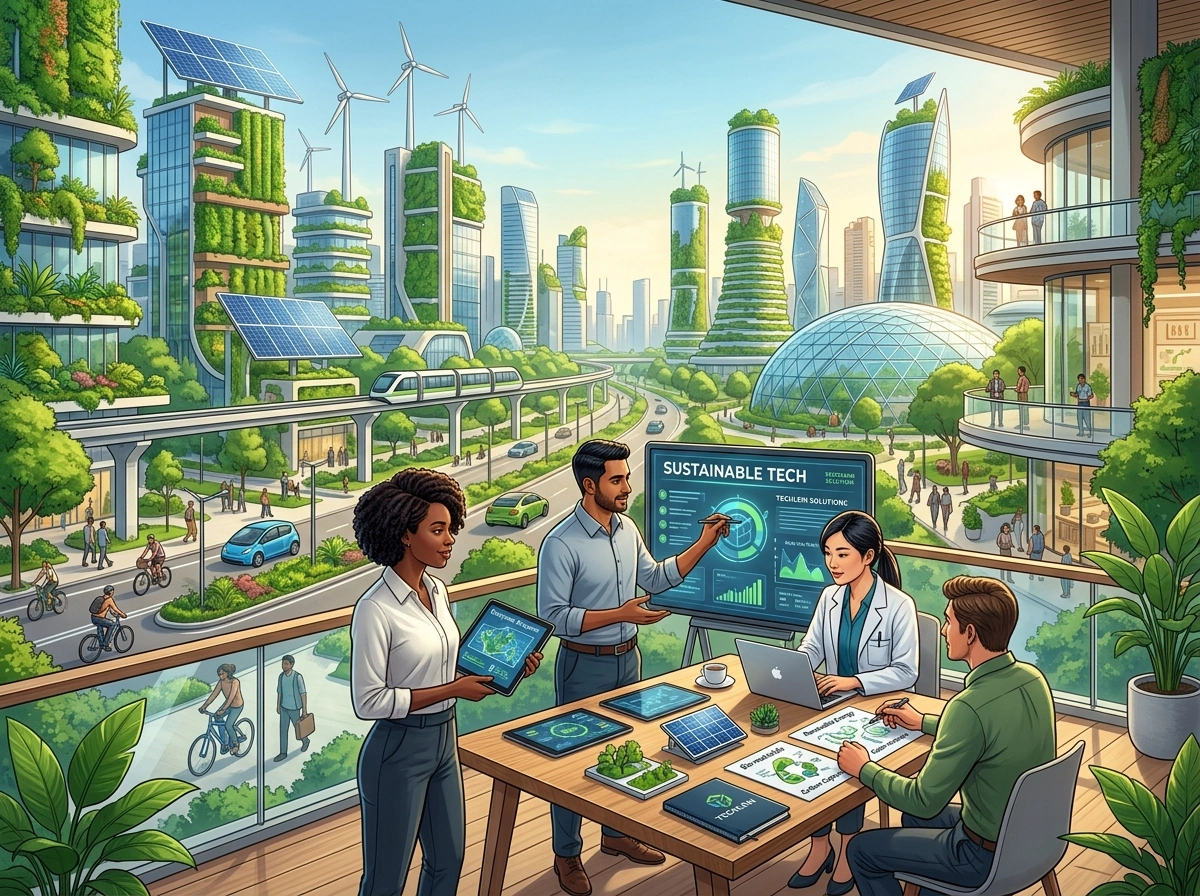
Climate change and shifting consumer demands have fundamentally transformed how modern businesses approach innovation. Corporate social responsibility is no longer a peripheral initiative or a simple marketing tool. It has evolved into an essential operational mandate that dictates how companies design, build, and deploy their digital infrastructure. As the global digital footprint expands, the environmental cost of massive data centers and sprawling hardware supply chains becomes impossible to ignore.
Techlein understands that the future of business relies on integrating environmental stewardship directly into the technology stack. The company views sustainable technology development as a critical component of long-term operational viability. By completely overhauling legacy operations and prioritizing ecological health alongside technical performance, Techlein sets a new standard for modern enterprises.
This comprehensive guide explores Techlein’s philosophy on sustainability, detailing the core principles, innovative technologies, and ethical frameworks that guide their operations. Readers will gain valuable insights into how organizations can reduce their carbon footprint, adopt a circular economy, and build resilient architectures that support both business growth and environmental preservation.
Core Principles of Techlein’s Sustainable Development
At the heart of Techlein’s strategy is a transition from outdated, monolithic systems to agile, highly automated architectures. This shift represents a fundamental restructuring of how business value is delivered through software. The traditional approach to scaling technology often involved massive overhead and wasted resources. Techlein counters this by focusing on hyper-scalability and the intelligent integration of artificial intelligence at every layer of the technology stack.
A key pillar of this approach is the adoption of rigorous FinOps practices. Engineering teams are now directly responsible for the financial and environmental impact of their architectural decisions. By deeply analyzing cloud expenditures, Techlein ensures that compute resources are utilized with maximum efficiency. This cultural shift aligns financial accountability with ecological responsibility, proving that cost-effective architecture is often the most sustainable architecture.
Furthermore, Techlein prioritizes absolute carbon reduction over traditional carbon offsetting. While planting trees and investing in renewable projects remain valuable, the primary focus is on eliminating emissions at the source. This involves optimizing code efficiency so that software requires fewer CPU cycles to execute tasks. By deploying AI to dynamically manage power usage across their entire infrastructure, Techlein minimizes energy waste before it ever occurs.
Innovative Technologies and Green Solutions
Techlein leverages a suite of advanced technologies to drive its green initiatives. Green IT forms the foundation of these efforts, particularly concerning data center operations. Recognizing that data centers consume massive amounts of global electricity, Techlein migrates workloads to sustainable cloud computing architectures powered entirely by renewable energy. The implementation of intelligent cooling systems and comprehensive hardware lifecycle management further drives down energy consumption.
The transition to serverless computing and edge networks plays a massive role in this sustainable ecosystem. Traditional server setups often run continuously, burning energy even when demand is low. Techlein’s optimized compute instances scale down to zero when not in use. The integration of advanced analytics allows the business to precisely forecast demand and provision resources dynamically. This virtually eliminates wasted compute cycles, drastically reducing both overhead costs and energy expenditure.
The developer experience at Techlein has also been revolutionized by AI-assisted coding tools and large language models. Engineers act as orchestrators of AI agents, spending less time writing repetitive boilerplate syntax and more time designing resilient, efficient architectures. This new paradigm empowers developers to solve complex domain-specific logic while maintaining a strict focus on system efficiency. Unified platforms provide end-to-end visibility, offering real-time insights into performance regressions and potential vulnerabilities, which ultimately prevents resource-heavy system failures.
Environmental Impact and Resource Management
Techlein takes a holistic approach to resource management by embracing the circular economy. The traditional tech industry relies heavily on a “take-make-dispose” model, leading to massive amounts of electronic waste. Techlein disrupts this cycle by designing hardware for longevity, repairability, and ultimate recyclability. Programs that incentivize e-waste recycling and device refurbishment lower the overall environmental impact while creating sustainable new revenue streams.
Beyond hardware, Techlein recognizes that the modern workforce configuration heavily influences environmental outcomes. The stabilization of hybrid and remote work models serves as a powerful green strategy. By maintaining a distributed workforce, Techlein significantly decreases commuting emissions and office energy use. Advanced project management tools ensure that high productivity is maintained without the heavy carbon footprint associated with large, centralized office spaces.
Data governance also plays a surprising role in resource management. By strictly controlling where data is processed and stored, Techlein minimizes unnecessary data transmission across global networks. Techniques like cryptographic data sharding and advanced anonymization ensure that data is handled efficiently and securely. This localized approach to data processing reduces the energy required to transmit massive datasets across long distances, further lowering the company’s carbon footprint.
Corporate Responsibility and Ethical Standards
A company’s environmental impact extends far beyond its immediate internal operations. Techlein understands that true sustainability requires deep visibility into the entire supply chain. To achieve this, the company implements transparent, blockchain-verified tracking systems. This allows Techlein to audit its supply chain continuously, ensuring that all vendors and partners adhere to strict environmental and ethical standards. Comprehensive corporate sustainability is only possible when every link in the chain operates responsibly.
Global regulatory bodies continually implement stringent Environmental, Social, and Governance (ESG) reporting requirements. Techlein embraces these mandates not just as legal obligations, but as opportunities to demonstrate ethical leadership. The company utilizes sophisticated software to monitor its emissions in real-time, ensuring accurate data collection and transparent reporting. This proactive approach to compliance prevents financial penalties and builds deep trust with consumers and enterprise partners alike.
Security is another vital component of corporate responsibility. In a landscape filled with sophisticated threats, Techlein defaults to zero-trust architecture. Remote work and global access necessitate a security model where every access request is strictly authenticated and authorized continuously. By integrating automated compliance auditing deeply into continuous integration and continuous deployment pipelines, Techlein guarantees that no code reaches production if it violates regulatory policies or privacy-by-design principles.
Future Outlook for Techlein and the Industry
Looking toward the horizon, Techlein prepares for the convergence of quantum computing precursors, advanced artificial intelligence, and decentralized networks. This impending technological shift requires architectures that are not just scalable, but fundamentally adaptable. Techlein champions the concept of the “composable enterprise,” where business capabilities are exposed as flexible, independent interfaces. This strategy serves as the blueprint for future-proof design, allowing organizations to rapidly iterate without constantly rebuilding resource-heavy foundational systems.
Success in this rapidly evolving era demands a culture of continuous learning and psychological safety. Techlein actively encourages its engineering teams to experiment with emerging technologies while maintaining rigorous operational discipline. Leadership understands that technology acts as the primary driver of business innovation and value creation in an increasingly interconnected world. By fostering an environment where junior developers can use AI assistants to rapidly grasp complex architectures, Techlein ensures that its workforce is prepared to tackle the sustainability challenges of tomorrow.
The transition toward sustainable technology is a continuous journey rather than a final destination. Techlein’s commitment to iterating on its green infrastructure proves that technological advancement and environmental stewardship can coexist harmoniously. As digital-native competitors attempt to keep pace, Techlein’s foundational investments in sustainable architecture provide a distinct, enduring competitive advantage.
Building a Sustainable Ecosystem Together
Embracing sustainable business practices is critical for the long-term viability of any modern enterprise. By integrating green IT, optimizing complex supply chains, and focusing on absolute emission reductions, companies can protect the environment while simultaneously improving operational efficiency. Techlein demonstrates that environmental responsibility is a catalyst for innovation, driving better hardware design, smarter software architecture, and more ethical business operations.
Organizations looking to thrive in the coming decades must follow this blueprint. It requires a willingness to dismantle legacy systems, invest in automation, and prioritize planetary health alongside corporate growth. We encourage business leaders, developers, and IT professionals to explore Techlein’s advanced solutions and join the movement toward a more sustainable, resilient digital future.
Frequently Asked Questions
How does Techlein manage the environmental impact of legacy systems?
Legacy systems are notoriously inefficient and consume vast amounts of energy. Techlein systematically decouples these systems using the strangler fig pattern. This technique allows functionality to be gradually migrated from massive, energy-draining monoliths to modern, independent microservices. This ensures that ongoing mission-critical business operations are not disrupted while the underlying infrastructure becomes significantly greener.
What are the financial implications of migrating to sustainable IT?
While the initial modernization process requires significant capital expenditure and training investments, the long-term financial benefits are substantial. Operational expenses are drastically reduced through comprehensive automation, optimized resource utilization, and a reduction in wasted compute cycles. Furthermore, sustainable architectures typically experience fewer critical security incidents and downtime events, protecting the company’s bottom line.
How does Techlein prevent vendor lock-in when utilizing green cloud services?
Relying on specific proprietary managed services can increase the risk of vendor lock-in. To proactively mitigate this risk, Techlein adopts comprehensive multi-cloud strategies. By heavily utilizing open-source abstraction layers like Kubernetes, the company maintains workload portability. This flexibility allows Techlein to negotiate better terms and shift resources to whichever cloud provider offers the most sustainable and cost-effective infrastructure at any given time.
Please visit the official site for more info.